 Favorite (1)
Microfluidic technologies are enabling a new generation of solutions across molecular diagnostics, genomics, cell analysis and point-of-care testing. By precisely controlling small volumes of fluids within highly integrated consumables, these systems can automate complex laboratory workflows while reducing sample and reagent consumption.
Over the last decade, significant advances in microfluidic design and assay development have generated a growing number of promising applications. Yet, despite excellent laboratory results, many innovations struggle to reach commercial adoption. The challenge is often not demonstrating functionality, but ensuring that a device can be manufactured reliably, reproducibly and at scale.
As microfluidic devices become increasingly sophisticated, industrialization is emerging as one of the key factors determining successful market adoption.
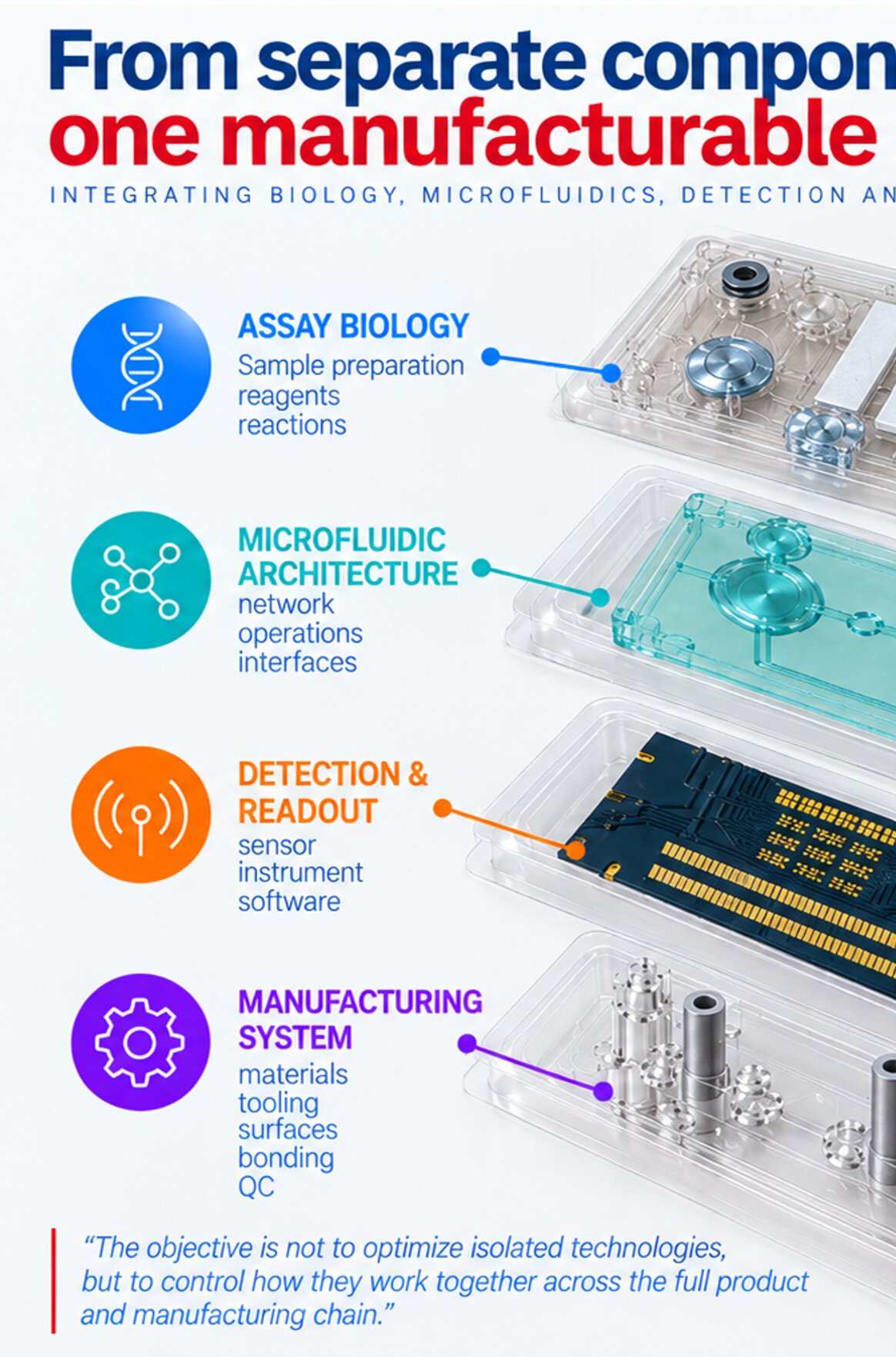
Modern microfluidic consumables combine a broad range of technologies within a single product. Precision injection moulding, surface treatment, reagent integration, biofunctionalization, fluid management, assembly and quality control must all work together to deliver the desired performance.
Although each process can be optimized individually, the greatest challenges often arise from their interactions. Material selection can impact surface treatment efficiency. Surface properties can influence biomolecule immobilization. Assembly conditions can affect reagent stability and overall assay performance.
For this reason, industrialization cannot be considered a final development step. It must be addressed from the earliest stages of product design. Successful scale-up requires a system-level perspective that considers not only individual technologies, but also how they interact throughout the manufacturing chain.
Experience across the industry shows that many development risks emerge precisely at these interfaces, creating costly redesigns and delays when manufacturability is addressed too late.
At ERREKA Medical, one of the most important lessons learned from industrial projects is that successful microfluidic development should not start with microfluidics alone. Many innovative concepts originate from biological protocols developed at laboratory scale, but directly transferring these workflows into a microfluidic cartridge can introduce significant technical and manufacturing risks.
For this reason, projects often begin with a detailed analysis of the biological protocol itself. Through our Class II BioLab capabilities, assay workflows can be evaluated, optimized and challenged before being translated into a microfluidic architecture. Understanding the critical biological requirements at this stage helps establish a solid foundation for subsequent development.
Rather than integrating all functionalities into a complete device from the outset, ERREKA follows a modular development strategy based on a "de-risking by design" philosophy. Complex workflows are broken down into manageable functional modules such as sample preparation, reagent integration, fluid handling or biochemical reactions. Each module is independently developed and validated before being progressively integrated into a complete system.
This approach reduces uncertainty, accelerates learning cycles and enables technical challenges to be identified and solved in a controlled manner. Most importantly, it creates confidence that the final integrated device will perform as expected.
Equally important is the early involvement of manufacturing and operations teams. Material selection, tooling concepts, assembly strategies and quality requirements are considered from the beginning of development rather than after a functional prototype has been completed. By bringing manufacturing expertise into the design phase, scalable solutions can be selected early, significantly reducing industrialization risks.
This multidisciplinary methodology brings together bioscientists, microfluidic engineers, manufacturing specialists and quality experts with a shared objective: transforming complex biological workflows into robust, scalable and manufacturable products.
The future success of microfluidics will depend not only on scientific innovation, but also on the ability to industrialize increasingly sophisticated systems.
As devices incorporate greater levels of integration and functionality, closer collaboration between biology, engineering and manufacturing disciplines will become essential. Industrialization can no longer be viewed as the final phase of development. It must become an integral part of the innovation process itself.
At ERREKA Medical, this vision drives the development of advanced microfluidic consumables, helping bridge the gap between laboratory innovation and industrial reality.
Because in microfluidics, innovation creates opportunity, but industrialization is what ultimately brings that opportunity to market.